
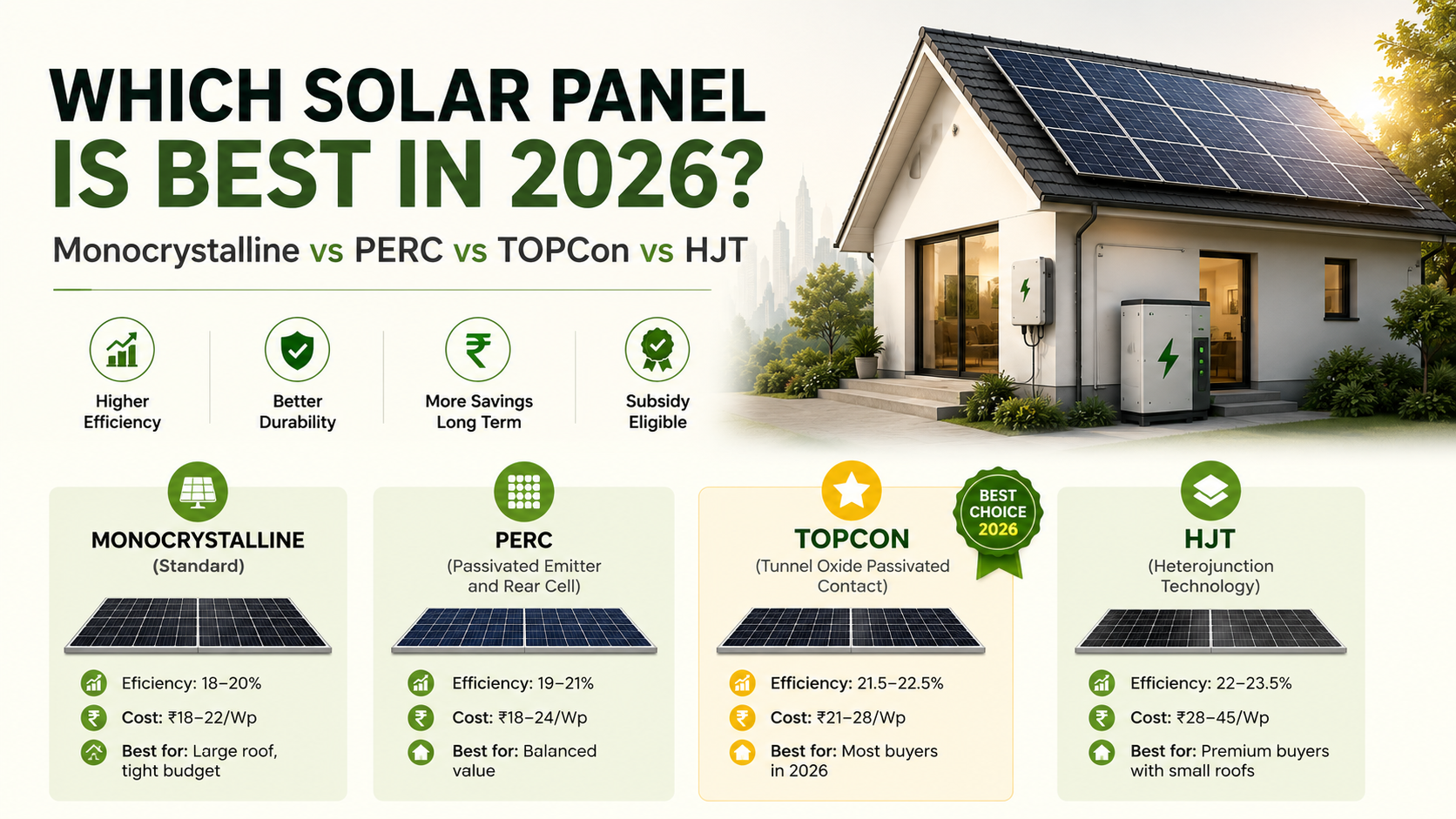
Which Solar Panel is Best in 2026? Monocrystalline vs PERC vs TOPCon vs HJT
In this blog, we compare the best solar panel technologies in 2026 including Monocrystalline, PERC, TOPCon, and HJT to help you choose the right panel for your home or business.
This guide is shared by Ankit Vyas the MD of Green Ocean Solar who helps homeowners and businesses choose the right solar panel technology based on real world performance and long term value.
Best Solar Panel in 2026 Quick Summary
- TOPCon is the best solar panel for most Indian buyers. It is efficient, made in India and eligible for subsidy.
- HJT has high efficiency on paper. But it is a newer technology. Most HJT panels in India are imported and do not qualify for subsidy.
- PERC is an affordable option, best for buyers with large roofs and tighter budgets.
For most homeowners and businesses in 2026, TOPCon is the best solar panel. It offers the right mix of efficiency, durability and cost.
This guide breaks down all 4 major solar panel types – Monocrystalline, PERC, TOPCon and HJT with their pros and cons and costs, so that you can make a real decision.
Important articles: PM Surya Ghar Muft Bijli Yojana
4 Solar Panel Technologies Explained
1. Monocrystalline (Standard)
Monocrystalline panels are made from a single crystal of silicon. They are the foundation of modern solar. Most advanced panels today like PERC, TOPCon, and HJT are all built on monocrystalline silicon.
Monocrystalline panel is a standard mono panel without any advanced rear-side or passivation upgrades.
- Efficiency: 18–20%
- Best for: Budget buyers with large roof space
2. PERC (Passivated Emitter and Rear Cell)
PERC improved on standard mono by adding a reflective passivation layer on the rear of the cell. This lets unused light bounce back for a second pass at generating power.
PERC dominated the Indian market from 2018 to 2023. It uses P-type silicon, which is prone to a phenomenon called Light Induced Degradation (LID), a small output loss in the first weeks of use.
- Efficiency: 19–21%
- Degradation rate: ~0.5–0.7% per year
- Temperature coefficient: −0.35%/°C
- Best for: Buyers who want reliable performance at a lower cost
3. TOPCon (Tunnel Oxide Passivated Contact)
TOPCon is the best solar panel for most Indian buyers in 2026. It adds an ultra-thin tunnel oxide layer and polysilicon contacts on the rear of the cell. It uses N-type silicon, which eliminates Light Induced Degradation entirely.
What makes TOPCon the right choice is not just performance but also trust. TOPCon has been installed at scale globally for over five years. Real-world data confirms the efficiency and degradation figures. Banks finance it. Manufacturers back it with strong warranties.
In India, every major domestic manufacturer – Adani, Waaree, Tata Power Solar, Vikram Solar, Goldi produces TOPCon at scale. As of early 2026, TOPCon accounts for over 60% of all new global solar module production capacity (SurgePV, May 2026). All ALMM-listed TOPCon panels are eligible for PM Surya Ghar subsidy.
- Efficiency: 21.5–22.5%
- Degradation rate: ~0.40% per year — field-validated
- Temperature coefficient: −0.30%/°C
- Track record: Proven at scale across India and globally
- Best for: Most Indian homeowners and businesses in 2026
4. HJT (Heterojunction Technology)
HJT is the most advanced mainstream solar technology available today. It combines crystalline silicon with thin layers of amorphous silicon to form a heterojunction. This reduces electron loss and delivers the highest efficiency and the best low-light performance of any silicon panel.
On paper, HJT wins across almost every technical metric. Lower degradation. Better heat tolerance. Higher efficiency.
But there is an important caveat. HJT is a relatively new technology. It has not yet accumulated 15 to 25 years of real-world installation data, especially in Indian conditions. Most independent long-term performance reviews are still based on lab projections, not field results.
In India specifically, HJT supply is limited. Most panels are imported from manufacturers like Risen and LONGi. Domestic HJT production is at an early stage. And imported HJT panels are generally not eligible for PM Surya Ghar subsidy.
- Efficiency: 22–23.5%
- Degradation rate: ~0.25–0.27% per year (lab-projected)
- Temperature coefficient: −0.24%/°C
- Availability in India: Limited — mostly imported
- Long-term field data: Not yet available at scale
- Best for: Premium buyers with small roofs who are not claiming subsidy and are comfortable with a newer technology
We have a detailed guide comparing the current types of Solar panels and their technical details for you to understand them better: Adani vs Waaree vs Tata Solar Panels
Quick Comparison – Monocrystalline vs PERC vs TOPCon vs HJT
| Feature | Mono (Standard) | PERC | TOPCon | HJT |
|---|---|---|---|---|
| Silicon type | P-type | P-type | N-type | N-type |
| Efficiency | 18–20% | 19–21% | 21.5–22.5% | 22–23.5% |
| Degradation/year | 0.7–1% | 0.5–0.7% | 0.40% | 0.25–0.27% |
| Price | ₹18–22/Wp | ₹18–24/Wp | ₹21–28/Wp | ₹28–45/Wp |
| Best for | Large roof, tight budget | Balanced value | Most buyers in 2026 | Premium, small roofs |
How India’s Climate Affects Your Panel Choice?
India is hot and humid. Solar panels lose efficiency when temperatures rise. This is called the temperature coefficient, the percentage of power a panel loses for every degree above 25°C.
On a summer afternoon in Bhopal, a rooftop panel can reach 55–60°C. That is 30–35°C above the standard test temperature of 25°C.
At those temperatures, here is how much output each technology loses:
- PERC (−0.35%/°C): loses approximately 12% of its output
- TOPCon (−0.30%/°C): loses approximately 10%
- HJT (−0.24%/°C): loses only approximately 8%
Over 25 years, this difference adds up to thousands of units of additional electricity, especially for high-consumption homes and commercial setups.
For most Indian buyers, TOPCon strikes the right balance. You get meaningfully better heat tolerance than PERC at a reasonable cost. If you have a small roof or very high usage, HJT gives you the best long-term yield per square foot.
Also read: Solar Panel Efficiency Explained – 18% vs 20% vs 23%
Which Panel Type Affects Your Long Term Savings?
The better the technology, the less it degrades each year. And degradation compounds over time.
A TOPCon panel degrading at 0.40% per year retains roughly 90% of its output at year 25. A PERC panel degrading at 0.55% per year retains closer to 87–88%.
On a 5 kW system, that 2–3% lifetime difference can translate to thousands of rupees in additional electricity savings over the life of the system.
Also read: All You Need to Know About Solar Panel Degradation
Final Verdict
For most homes and businesses in Madhya Pradesh, TOPCon is the smart choice in 2026. It is efficient, made in India, fully subsidy-eligible, and most importantly, proven in real-world conditions.
HJT is technically impressive. The numbers look excellent. But it is a newer technology. Independent long-term field data is still limited. Availability in India remains narrow. And subsidy eligibility is uncertain.
When you are making a 25-year investment, proven matters. That is why TOPCon wins for most buyers today. If budget is the primary concern, PERC remains a solid, time-tested option.
Read our blog on – Types of solar inverters explained
Thinking About Going Solar in Bhopal?
At Green Ocean Solar, we help businesses and homeowners choose the right panel technology as per their roof size, usage and budget. Explore our residential solar solutions in Bhopal or connect with us on Whatsapp!