
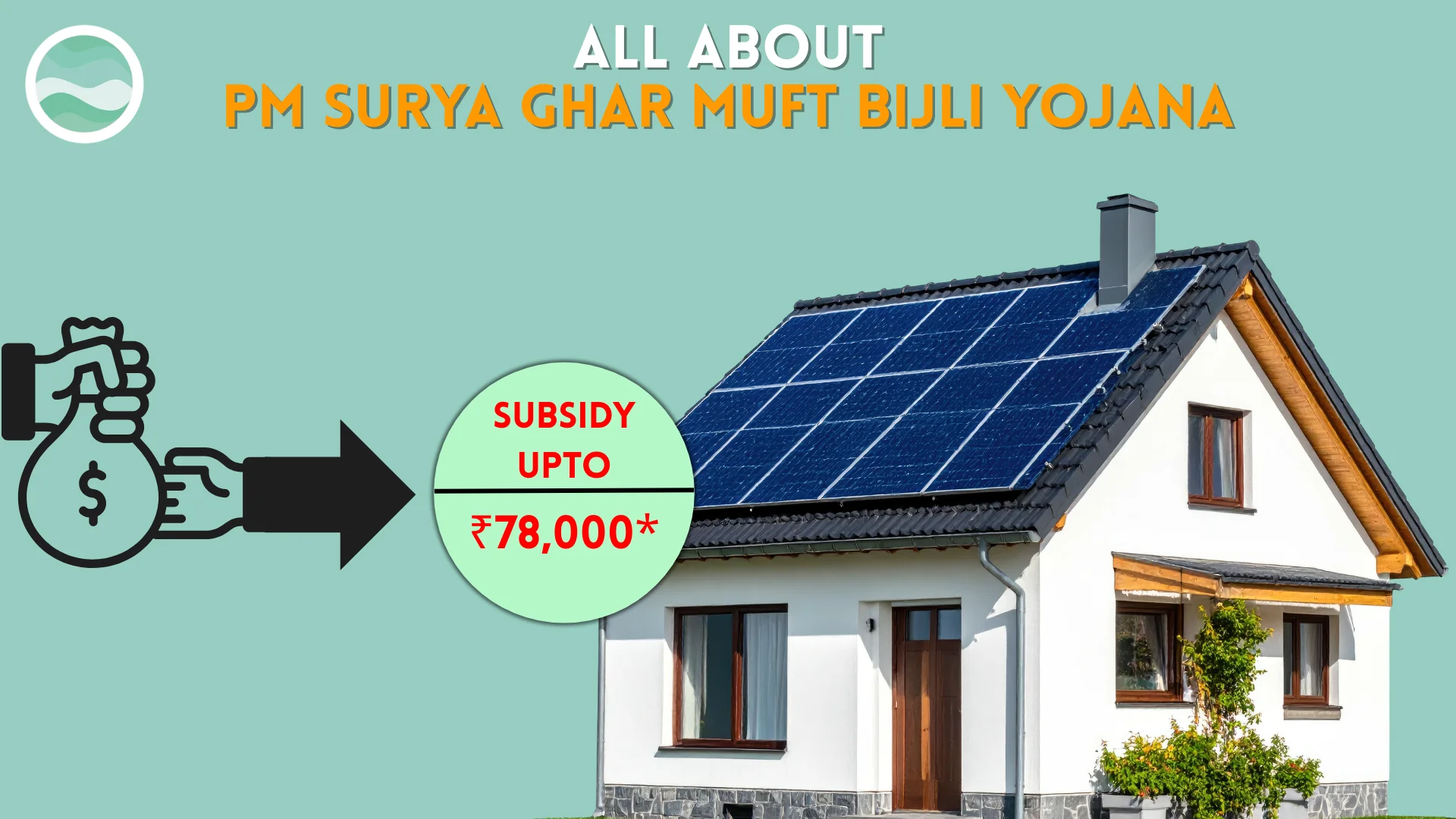
Electricity bills in Indian households have increased over the years. Air conditioners, work-from-home setups, electric kitchens, and charging devices all add up. To cater to this rising costs, homeowners are embracing solar energy, especially in tier-2 and tier-3 cities.
Recognising this shift, the Government of India has introduced strong financial incentives to make solar more affordable for people.
One of the most important initiatives in this direction is the PM Surya Ghar Muft Bijli Yojana. Under this scheme, residential consumers can install rooftop solar panels with a Government subsidy and significantly reduce their monthly electricity bills.
Read on to know more about PM Surya Ghar Muft Bijli Yojana, its subsidy amount, eligibility and how to apply for this scheme.
What Is Solar Power Subsidy in India?
A solar panel subsidy is financial assistance provided by the government to reduce the upfront cost of installing rooftop solar systems. Instead of paying the full installation cost, eligible households receive a subsidy that significantly lowers their initial investment.
In India, solar subsidies for homes are provided through the Ministry of New and Renewable Energy (MNRE) and apply only to on-grid rooftop solar systems.
The subsidy amount is directly credited to the beneficiary’s bank account after installation and inspection, which keeps the process transparent.
All You Need to Know About PM Surya Ghar Muft Bijli Yojana
The PM Surya Ghar Muft Bijli Yojana is an ambitious solar power scheme started by the Central Government in January 2024. It aims to promote rooftop solar adoption among residential households in India.
The Central Government has allocated INR 75,000 Crores for this scheme. It aims to provide up to 300 units of free electricity to up to 1 Crore Indian households. Through this scheme, the Government aims to empower middle and lower-income families by lowering electricity costs and encouraging clean energy usage.
Unlike older subsidy programs that were fragmented and state-specific, this scheme is backed by a centralised online portal, predefined subsidy slabs, and faster disbursal mechanisms.
Subsidy Amount Under PM Surya Ghar Bijali Yojana
Under the PM Surya Ghar scheme, the subsidy is linked to the capacity of the rooftop solar system installed.
Here are the subsidy details:
- Subsidy for 1-2kW solar system is INR 30,000 per kilowatt.
- Subsidy for additional capacity over and above 2kW upto 3 kW s INR 18,000
- Subsidy for 3kW and higher capacity is INR 78,000.
For example, A 1 kW system can receive up to ₹30,000 subsidy, 2 kW system can receive up to ₹60,000 subsidy and a 3 kW system can receive up to ₹78,000 subsidy.
However, the Central Government has capped the subsidy for homeowners to a maximum of INR 78,000. Any capacity beyond 3 kW does not receive additional subsidy, though households are free to install larger systems at their own cost.
This solar subsidy scheme is only applicable for residential on-grid solar use. It is not applicable for commercial and industrial usage.
Objectives of PM Surya Ghar Muft Bijali Yojana
The ambitious solar scheme by Indian Government has following long-term objectives:
- Promote the adoption of renewable and clean energy
- Reduce monthly electricity bills for Indian households, especially lower-middle-class and middle class households.
- Support India’s commitment to climate action and carbon reduction.
- Create employment opportunities in the solar installation ecosystem.
Who Can Avail Solar Panel Subsidy in India?
If you fulfil all conditions below, you can avail a subsidy under this scheme:
- You are a homeowner with a rooftop at your home.
- You should have an electricity connection in your name
- You have never availed of a solar subsidy for up to 3 kW systems
- You are installing an on-grid rooftop solar system.
Documents Required to Get Subsidy Under PM Surya Ghar Bijali Yojana
- Latest electricity bill
- Proof of property ownership
- Proof of identity, like an Aadhar card or PAN card
- Passport-size photos
How to Apply for Solar Panel Subsidy in India?
- Login to PM Surya Ghar Bijali Yojana Website
Visit the official website of PM Surya Ghar Bijali Yojana and register using your mobile number. - Create Your User Account
Choose your state, district, and electricity distribution company (DISCOM). Enter your electricity consumer or customer account number to complete registration. - Fill in Application Details
Provide basic personal information such as your name and gender, along with details from your most recent electricity bill. - Upload Supporting Documents
Submit the required documents, including identity proof, property ownership proof, and a copy of your latest electricity bill. - Add Bank Account Information
Enter your bank details for subsidy disbursal and upload a cancelled cheque to ensure accurate fund transfer. - Select Empanneled Solar Vendor
From the list provided on the portal, choose a DISCOM-approved solar installer to carry out the rooftop solar installation at your home. - Installation of Net Meter
After the solar system is installed, your DISCOM installs a bi-directional net meter to record both electricity consumption and surplus power exported to the grid. - Receive Commissioning Certificate
Once the system is verified and activated, the DISCOM issues a Solar Commissioning Certificate confirming that the installation is operational. - Submit Subsidy Claim
Log back into your portal account and upload the commissioning certificate to formally apply for the subsidy. - Receive Subsidy in Your Bank Account
After approval, the sanctioned subsidy amount is directly transferred to your bank account, usually within 30 days.
Benefits of Solar Panel Subsidy in India
There are umpteen long-term benefits of solar panels for the home and solar subsidy schemes like PM Surya Ghar Bijali Yojana.
- Lower Electricity Bills
You can significantly reduce your electricity bills or even eliminate them entirely, depending on your usage. - Long Term Financial Savings
Once the initial investment breaks even in 3-5 years, you can get free electricity throughout the lifespan of a solar system, which easily lasts for 25 years. - Reduced Upfront Cost
By availing a subsidy of INR 78,000, you can bring down the initial cost required to set up rooftop solar. This makes solar affordable for more families. - Clean & Green Energy
Rooftop solar helps cut carbon emissions and supports India’s clean energy goals. - Energy Independence
Generating power at home reduces reliance on the grid and protects against future tariff hikes. - Reliable & Low Maintenance
Solar systems have minimal upkeep requirements and are designed for long operational life.
Conclusion
For homeowners who have been considering residential rooftop solar but hesitated due to cost or complexity, the PMSGMBY makes the decision easier and more practical. If you plan it right and follow the official process, the solar panel subsidy in India can help you transition to clean energy with confidence and long-term savings.
FAQs
After installation and inspection, the subsidy amount is credited to your bank account in 30 days.
No, the subsidy is not available for residential societies or apartments. This is only applicable for individual households.
To be eligible for a subsidy, you must select from the list of empanelled vendors available on the national portal.
Maintenance is usually handled by the vendor and is not part of the subsidy itself.