
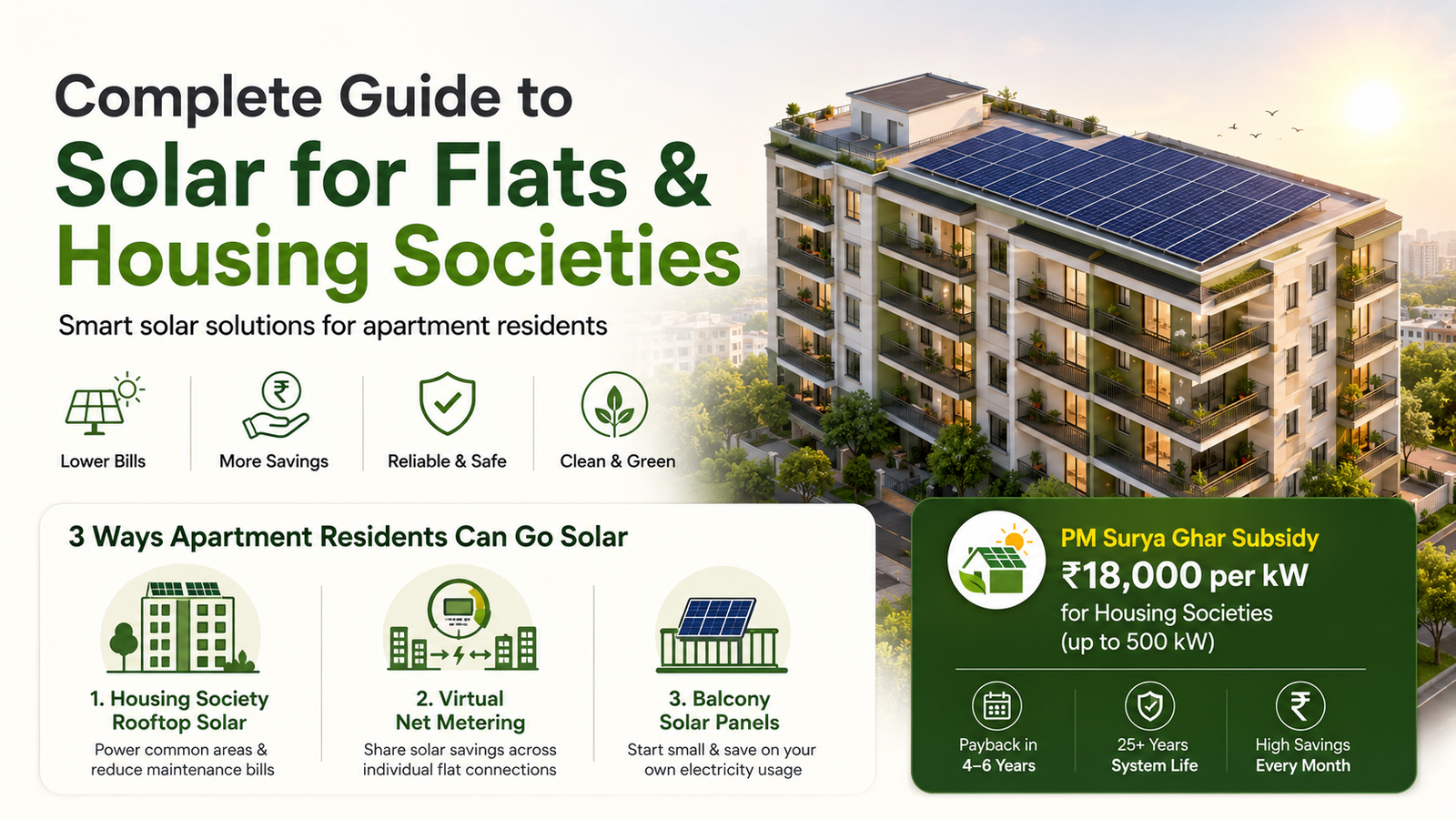
In this blog, we explain how solar panels for apartments work, including housing society rooftop systems, virtual net metering, balcony solar, and the available government subsidies.
This guide is shared by Ankit Vyas the MD of Green Ocean Solar who helps homeowners and housing societies choose the right solar solutions based on their energy needs and available rooftop space.
TLDR – Key Takeaways
- Apartment residents can go solar but it works differently from independent homes.
- Housing societies can install a shared rooftop system to power lifts, pumps, and common lighting.
- Virtual net metering allows one rooftop system to distribute savings across individual flat connections.
- Balcony solar panels (300–600W) are an option for residents wanting to start small on their own.
- Under PM Surya Ghar, housing societies get ₹18,000/kW subsidy for common area systems, up to 500 kW.
- In Bhopal, your DISCOM is MPMKV (Madhya Pradesh Madhya Kshetra Vidyut Vitran Company).
- Payback for housing society solar: 4–6 years. System life: 25+ years.
Over 65% of urban Indians live in apartments or multi-storey housing. But most solar conversations still assume you own a bungalow with a private terrace.
The truth is, apartment residents can go solar. It just works differently.
This guide explains the three routes available – housing society rooftop solar, virtual net metering, and balcony panels and what residents in Madhya Pradesh need to know.
Can You Install Solar Panels If You Live in a Flat?
You cannot install solar panels on the common rooftop as an individual. Any installation on it requires the approval of the housing society. But that does not mean solar is off the table.
There are 3 practical ways apartment residents can embrace solar:
- Housing society installs solar on the rooftop
- Virtual net metering where one rooftop shares credits across individual flat connections
- You can also install balcony solar panels.
Each option suits different situations. Let’s look at each one in detail.
1. Housing Society Rooftop Solar
This is the most common and financially effective route for apartments.
The housing society installs a solar system on the shared rooftop. The electricity generated powers common areas — lifts, water pumps, staircase lights, and security systems.
These loads are often the biggest contributors to your monthly maintenance charges. Housing societies in Indian cities have consistently cut common area electricity bills by 65–70% after going solar.
How Can a Society Go Solar?
- Pass an AGM resolution approving the installation
- Get a site assessment that includes auditing structural strength, rooftop area and shading analysis
- Select a reliable, MNRE listed vendor for installation
- Claim the PM Surya Ghar subsidy
Under the PM Surya Ghar Muft Bijli Yojana, housing societies are eligible for a subsidy of ₹18,000 per kW for common area systems — up to a maximum of 500 kW. A 50 kW system for a large society could attract ₹9 lakh in central subsidy alone.
Typical payback: 4–6 years. After that, the electricity is essentially free for the remaining 20+ year system life.
2. Virtual Net Metering
Virtual net metering (VNM) takes the housing society model a step further.
Instead of only powering common areas, one rooftop solar system generates electricity that gets credited to individual flat connections. Every participating resident sees a reduction on their own electricity bill, based on an agreed sharing formula set by the society.
How Virtual Net Metering Works
- The society installs one solar plant on the common roof
- A bi-directional meter tracks how much solar power is sent to the grid
- The DISCOM distributes energy credits to participating flat connections as per the agreed split
- Each resident’s bill reduces every month, in proportion to their share
The Central Government has issued guidance for states to implement VNM. Several state electricity regulators have already updated their rooftop solar rules to formally allow virtual and group net metering for residential multi-storey buildings.
This means solar benefits are no longer limited to common areas. Every flat in the society can participate without needing its own rooftop panel.
To understand how net metering credits work and how excess energy is settled, read our net metering guide and what happens when solar produces more than you use.
3. Balcony Solar Panels
If your housing society isn’t ready to go solar yet, balcony solar panels are a way to start on your own.
A 300–600W balcony kit uses portable mounting frames on your railing, no drilling into shared walls. These systems can power small appliances – fans, lights, a laptop, phone charging.
Estimated savings: ₹400–700 per month at ₹6–8 per unit tariff.
Important to note: Most balcony solar systems in India currently operate off-grid, they are not connected to the main DISCOM circuit. For grid-connected net metering on a balcony system, you need society approval, DISCOM clearance, and the system must be linked to your own electricity connection. Check with your DISCOM before proceeding.
Also read: Not sure which solar panel technology is right for your apartment? Read our complete guide comparing Monocrystalline, PERC, TOPCon, and HJT solar panels.
What About PM Surya Ghar Subsidy for Apartment Residents?
Apartment residents are eligible for the PM Surya Ghar Bijli scheme but the subsidy route differs depending on your setup.
| Setup | Who Applies | Subsidy Available |
|---|---|---|
| Individual flat with rooftop rights | Individual resident | ₹30,000–₹78,000 (based on system kW) |
| Housing society – common area system | Society | As per applicable government scheme |
| Balcony Solar (off-grid) | Individual resident | Not eligible |
Which Option Is Right for Your Apartment?
| Option | Best For | Estimated Bill Savings | Subsidy |
|---|---|---|---|
| Society Rooftop Solar | Reducing maintenance charges | High – 60–70% reduction in common area bills | Yes – ₹18,000/kW |
| Virtual Net Metering | Sharing solar savings across all flats | High – Individual bill reductions | Yes, same as above |
| Balcony Solar | Individual residents starting small | Moderate – ₹400–700 per month | No |
The larger the housing society, the larger the system and the bigger the collective savings. For individual homeowners, rooftop solar is simpler. For apartments, it takes coordination. But the savings are just as real.
You can also explore adding battery storage later to your society system for backup power during outages. Read our solar battery guide for 2026 to understand how that works.
Final Word
Living in a flat is no longer a reason to skip solar.
Housing societies in Bhopal and across Madhya Pradesh are increasingly adopting rooftop solar for common areas. Virtual net metering is opening the door for individual flat residents to benefit too. And balcony solar gives anyone a way to start small.
The government subsidy under PM Surya Ghar makes the financial case even stronger, particularly for societies acting collectively. If you’d like to explore solar panel installation services for your home or your business in Bhopal, we can also help with that.
Thinking about installing solar for your housing society in Bhopal? Talk to Green Ocean Solar. We will assess your rooftop, walk you through the subsidy process and give you an honest picture of what to expect.